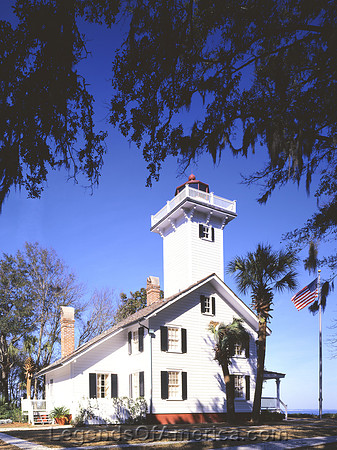
Haig Point Lighthouse. In December of 1872, James H. Reed of Washington D.C. was contracted to acquire all the material for the two range lights and dwelling, transport the material to the island, and supply the necessary labor to erect the structures all for $7,681. A two-story wooden keeper’s dwelling, with a tower extending from the eastern end of its pitched roof, was constructed on the foundation of Blodgett’s plantation mansion. To the south, the front range light was also built of wood. Ships would align the two range lights to safely enter Calibogue Sound. The entrance to the sound would move due to shifting sand, so the front range light was placed atop a pair of wooden rails along which it could be moved to track the sound’s entrance.